
What gauge aluminum is best for gutters In new england?
This video will help you understand what actually matters before you spend thousands on a new gutter system.
In this episode we cover:
✅ The difference between .027 and .032 aluminum thickness
✅ Why thicker aluminum can matter in New England weather
✅ How snow and ice affect seamless gutters over time
✅ The truth about “builder grade” gutter systems

.027 vs .032 Aluminum Gutters: What Builders in New Hampshire Should Actually Be Specifying
TL;DR
If you're building or designing in New Hampshire, .027 gutters will work—but they don’t hold up the same way long term.
.032 aluminum gives you better rigidity, fewer callbacks, and a system that handles snow load, ice, and runoff without failing early.
Why Aluminum Gauge Matters More in New Hampshire Than Anywhere Else
In a mild climate, gutter gauge is mostly a cost decision.
In New Hampshire, it’s a performance decision.
Between snow load, freeze/thaw cycles, and the amount of water moving off a roof during a storm, gutters aren’t just drainage—they’re part of the building envelope. When they fail, it’s rarely isolated. It turns into fascia damage, foundation issues, and ice problems that show up fast.
I’ve seen a lot of systems that technically “met spec” but didn’t hold up to real conditions here.
New England Gutter Systems uses only .032 Aluminum for our 5 and 6 inch gutters.
Why does New England Gutter Systems use only .032 aluminum for both 5 and 6 inch gutters?
We offer a life time labor warranty and that means if the gutters fail we have to come back to fix them. Our reputation is on the line.
If it’s a light-duty application, .027 may get the job done for a while we would rather not take the risk. We are a local family business. We depend on repeat customers positive reviews and referrals. Our best clients come from building trust in the community its not worth it to offer a product we feel will fail and cause issues.
Learn more about our seamless rain gutters :
https://www.newenglandguttersystems.com/seamless-gutter-installation
What .027 vs .032 Actually Means in the Field
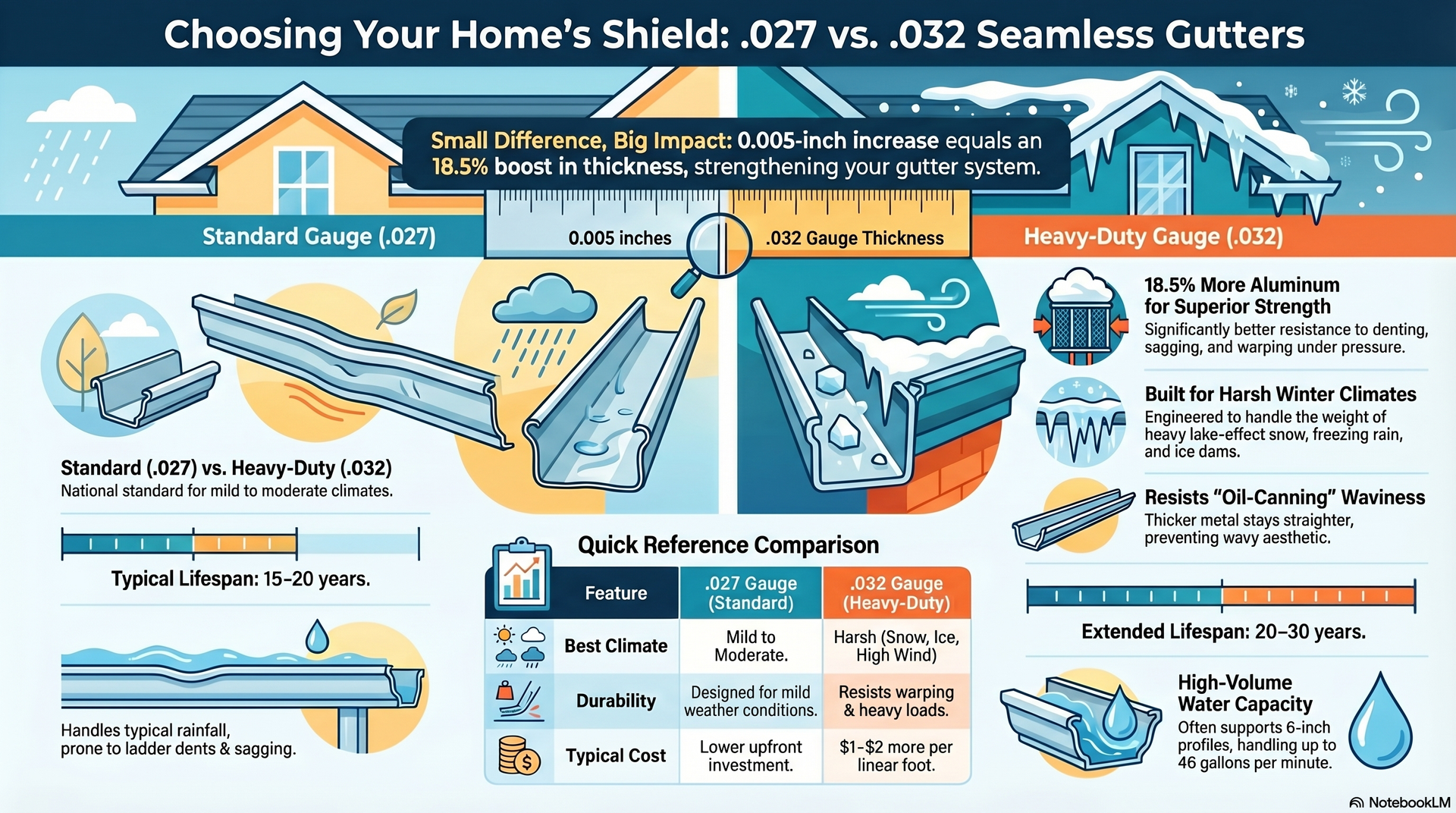
On paper, the difference is small five thousandths of an inch.
In the field, it’s not small at all.
That jump to .032 is roughly an 18% increase in thickness, but more importantly, it’s a noticeable increase in rigidity.
What that translates to in real terms:
* Less flex across long runs
* Better resistance to ladder pressure
* Reduced oil-canning and waviness
* Stronger support under snow and ice load
You can feel the difference just handling the material.
Where .027 Starts to Fall Short
.027 is still the default in a lot of specs, mostly because it’s been the industry standard for years.
And to be fair it installs fine. It looks good on day one.
But over time, especially in New England conditions, the weak points show up:
Oil-canning on longer runs after a few seasons
Denting from ladders, branches, or ice shedding
Subtle sagging in areas with debris buildup or heavy runoff
Movement at the fascia during freeze/thaw cycles
None of these are usually immediate failures. They’re the kind of issues that turn into service calls 2–5 years down the line.
Why More North East Gutter Installers Are Moving to .032 aluminium.
In my experience, .032 isn’t about overbuilding it’s about reducing risk.
Especially on:
* Larger rooflines
* Steeper pitches
* Homes surrounded by trees (pine needles are a big one here)
* Areas prone to ice dams
What stands out most with .032:
* It holds its line you don’t get that waviness over time
* It handles load better
snow, ice, and wet debris
* It takes abuse ladders, maintenance, real-world use
* It reduces callbacks which is what most builders actually care about
That last one matters. Once the siding and trim are finished, nobody wants to revisit gutters unless they absolutely have to.
It’s Not Just the Gutter It’s the whole water drainage System
Gauge alone doesn’t fix a bad install.
The systems that hold up in New Hampshire usually have a few things in common:
* Hidden hangers (not spikes)
* Tighter spacing than the typical 24" on center in problem areas
* Proper pitch for real water volume not just minimum slope
* Solid fascia backing
Why .032 Makes the Most Sense In New England's Heavy Snow and Rain
If you’re trying to standardize details or reduce long-term issues, .032 makes sense on:
* Homes over ~2,000 sq ft roof area
* Steeper roof designs where water moves fast
* Properties with heavy tree coverage
* Multi-story builds where access is limited
* Long-term ownership projects (custom homes, higher-end builds)
New England Gutter Systems uses .032 as a baseline spec New England where weather exposure is a constant factor.
Cost vs. Risk (The Real Tradeoff)
The material difference is usually around $1–$2 per linear foot.
Labor doesn’t change much.
So the real question isn’t cost—it’s exposure:
Are you okay with a higher chance of property damage?
Are you building something meant to last 20+ years without issue?
Because that’s really what this comes down to.
If the goal is:
Fewer callbacks
Better long-term performance
A cleaner look that lasts
.032 is the safer spec in this region.
It’s not about upselling it’s about building something that holds up to what New Hampshire actually throws at it.
Key Takeaways
The thickness difference is small—but the performance difference isn’t
.027 works, but shows wear faster dents and damages easier and will not last as long in New England conditions
.032 provides better rigidity, durability, and long-term appearance
Installation quality still matters just as much as material
Most long-term issues come from systems that were “good enough” on paper
If you're detailing builds in New Hampshire and want input on gutter specs that actually hold up in the field, I’m always open to talking through it.
If you're comparing gutter materials, it’s also worth looking at gutter size because aluminum thickness is only one part of the equation. See our guide to 5-inch vs. 6-inch gutter capacity to understand how gutter size affects water flow, roof runoff, and performance during heavy New England rain.